Interdependent scaling exponents in the human brain
10 November 2025
A single straight line ties together the scaling exponents of human brain activity across a large population. Researchers analyzed resting-state fMRI data of human brain activity of 714 subjects under a phenomenological renormalization group (PRG) approach that merges the most correlated brain regions at each iteration.
For each subject, three observables related to human brain activity — the variance of coarse-grained activity, log-probability of silence (no activity), and largest covariance eigenvalue — exhibit interdependent scaling laws, yielding a triplet of scaling exponents.
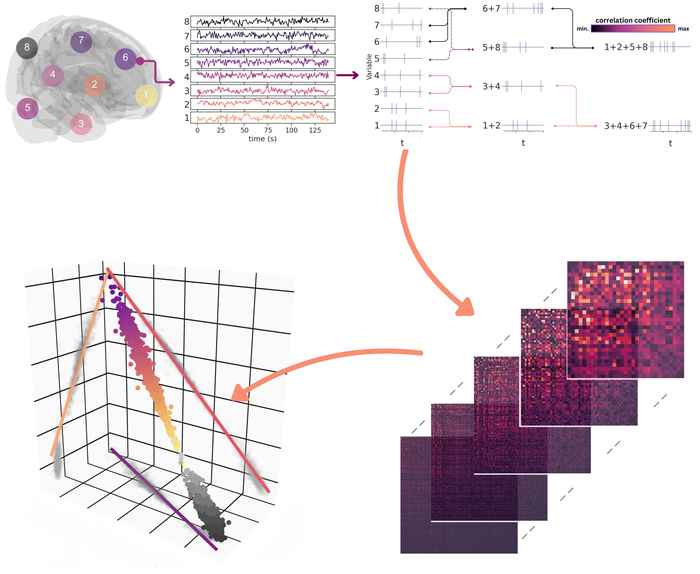
The authors discovered that these triplets are related to each other: when plotted in 3D exponents space, all participants’ points collapse onto a single straight line, revealing simple linear relations among the exponents. The authors derived these scaling relations analytically and confirmed their finding within the finite coarse-graining range permitted by the data.
This population-level alignment suggests shared constraints in human brain activity that shape multiscale brain organization — consistent with, though not a proof of, universal-like behavior. Exponents also correlate with grey-matter volume and cognitive performance, indicating potential links between multiscale dynamics, anatomy, and behavior.
More broadly, the work shows how finite-scale RG-inspired analysis can disclose interdependent laws in neural data and offers a quantitative basis for comparing individuals — and testing for similar constraints — in other complex systems.
Read the article published in Physical Review Letter here.